Book Review: Our Town: A Heartland Lynching, a Haunted Town, and the Hidden History of White America
Posted: Mon, Aug 14, 2006 
On August 7, 1930, the courthouse square in Marion, Indiana was the location of one of the most shocking events in the town's history -- the lynching of two young black men who were dragged from the city jail and brutally beaten before being hung from a tree in the square. A third young man escaped being lynched to tell the tale. Because of him, and because of an infamous photo of the scene showing hundreds of perpetrators and spectators viewing the crime, (a photo that was sold by the thousands in the days after) the event has never been forgotten, although it is spoken of rarely and with trepidation amongst the residents of the town. Journalist Cynthia Carr, who grew up in Marion and who's family has a long history there, set out to examine that event, the history of race relations in Indiana that led up to it, and the unspoken resonance from it that has haunted the town every since.
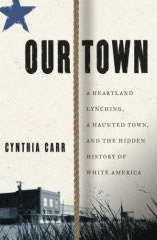
Our Town: A Heartland Lynching, a Haunted Town, and the Hidden History of White America
by Cynthia Carr
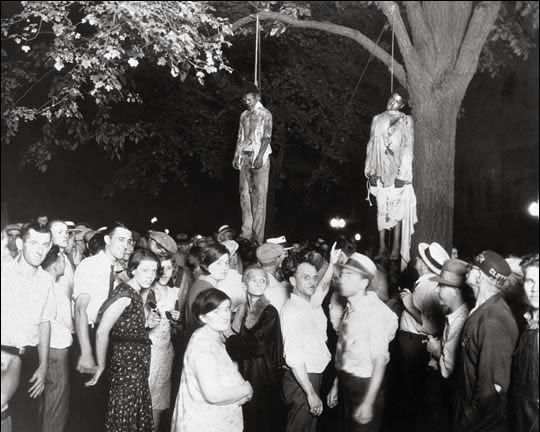
Every family in 1930s Marion had some sort of personal connection -- directly or indirectly -- to the lynching, and Carr's family is no exception, so her investigation of her town's history often takes a turn to the personal and reflective. Her willingness to confront that connection is clearly unusual in a town where residents both black and white just want the whole history to disappear into the mists of time -- a sentiment that is really the exact reason why the story just won't do so.
 Everyone in Marion has some evidence of the violent, covered-up crime hidden in their attics, sometimes literally and always figuratively, and piecing together what really happened that night, and who was involved (several men were tried for the lynching, but no one was convicted) becomes an exercise in frustration for Carr, who has to separate myth from rationalization from fact. But over time she teases out many details and assembles the most complete picture of the lynching that has ever been discussed in print.
Carr also reconstructs another compelling story -- Indiana's own history of the relationship between black folks and white folks. Prior to the civil war, Indiana had a strong history of abolitionism and activity on the underground railroad, but during reconstruction that history was virtually forgotten with the rise of the Ku Klux Klan in Indiana. It's estimated that during the 1920's one in every three white men was a part of the Klan, and Indiana was also home to numerous "sun down" towns -- where signs at the city limits warned black people not to let the sun go down on them in that town. Grand Dragon D.C. Stephenson's arrest in 1925 is often referred to as the event that "broke the back of the Klan" in Indiana, and it did mark a turning point in the popularity of the Klan, but the racist organization has never really disappeared from the state.
Carr was able to uncover the evidence of what role they played in the 1930 lynching and throughout Indiana's history. To understand the effects of racism even in the present day, and to uncover the extent of the KKK's influence today (some Marion residents wouldn't talk to her about the lynching for fear of retaliation from the Klan), Carr infiltrates the modern Klan and contrasts their current movement with past.
I'm very curious to see how this book was received in Marion, because it confronts quite a few painful truths about the town. But as Cynthia Carr concludes (and I agree) the only way to lay the story to rest and allow the town to heal may be to bring some of those truths out into the open for the first time.
TrackBacks
TrackBack URL for this entry:
http://www.indyscribe.com/cgi-bin/mt-tb.cgi/330
Categories
- About Us
- Board and Video Games
- Books
- Day Trips
- Events & Festivals
- Film & TV
- Geek Bling
- History
- Hoosier Oddities
- Indianapolis In the News
- Indianapolis Living
- Kids' Stuff
- Local Attractions
- Local Celebrities
- Museums and Visual Arts
- Music
- Night Life
- Photos
- Restaurants
- Shopping
- Sports
- Theater
- Transportation
- Weather

Archives
IndyScribe Authors
- Jennifer Bortel
- Brad Koch
- Brent Mundy
Comments
1. Aug 25, 06 04:27 PM | Lisa said:
That photograph is also the inspiration for the poem "Strange Fruit" by Lewis Allen that became a well-known song recorded by Billie Holliday.
Southern trees bear strange fruit
Blood on the leaves and at the root
Black bodies swingin' in the Southern breeze
Strange fruit hangin' from the poplar trees
Pastoral scene of the gallant South
The bulging eyes and the twisted mouth
Scent of magnolia, sweet and fresh
Then the sudden smell of burning flesh
Here is the fruit for the crows to pluck
For the rain to gather, for the wind to suck
For the sun to rot, for the tree to drop
Here is a strange and bitter crop
2. May 9, 07 07:20 PM | SHERRI said:
I was in total shock when i came across this on the internet. My husband was raised in Marion and was just as appalled at this as I. I always look for a true storie or a true ghost tale and it seems this is rolled into one. So sad this happened in what i thought was a quiet tiny town. My heart goes out to this incident and I pray things like this never happen to good people...no matter what color
3. Jan 25, 08 06:03 PM | Bernard said:
Why don't the people bring those responsable to justice then it can stop and be laid to rest
4. Apr 1, 08 01:52 PM | Colby said:
I was born and raised in Marion. I remember back when I was a kid when they cut down the tree at the courthouse. I can say from experience that the lynching wasn't something that was viewed or put out there as historically important. But, Black folks passed the lessons leared from generation to generation. Depending on what that lesson was, baby boomers, generation x, and every generation afterwards will have perceptions of the event that may not be similar. In my family, it was used as a reminder of what some white men are capable of. Other lessons taught by black families were don't even act like you are friends with a white woman or "they" will kill you. Some of this all seems crazy to today's generation, but knowing the past is essential to building our future. Marion Indiana's history did not begin or end with this event. It's simply a part of it all which can not and should not be ignored.
Marion now has the Urban League and NAACP. you will be hard pressed to find a town Marion's size with both of this organizations. My point, these organizations effected my upbringing as much as the lynchings did and we might not of had either one there if it wasn't for the public exposure of the lynching and the outrage it produced.
5. Dec 31, 11 12:54 PM | Will Simpson said:
I hate to say it, but Marion is not a tiny town. Gas City is a tiny town. Marion is a decent size.
6. May 17, 12 01:48 PM | hohi said:
i do like the manner in which you have framed this specific situation.
7. May 19, 12 03:38 AM | hohi said:
i do enjoy the way you have framed this concern.
8. Jul 25, 12 12:45 AM | Andrew E said:
How anyone not know about this that went to Marion High School as we had a teacher that told us about it for US History. We were talking about the rights moment era and he asked us if anyone in the class knew about the lynching. Like 2 people raised their hand, as he responded saying that he wasn't surprised as it was not a well talked about part of history for are town.
9. Jan 7, 13 09:11 AM | Madeleine said:
Oh my goodness! Awesome article dude! Thank
you, However I am encountering issues with your RSS.
I don't understand the reason why I cannot subscribe to it. Is there anyone else having the same RSS problems? Anyone who knows the solution will you kindly respond? Thanx!!
10. Mar 12, 13 01:15 AM | https://message.diigo.com/message/zulutrade-online-michel-astrelin-know-2098754 said:
Having read this I thought it was extremely informative.
I appreciate you spending some time and energy to put this article together.
I once again find myself personally spending a lot of time both reading and commenting.
But so what, it was still worthwhile!
11. Mar 17, 13 03:28 PM | zulutrade said:
Unquestionably believe that that you stated. Your favourite reason
appeared to be on the internet the simplest thing to understand of.
I say to you, I definitely get annoyed while other people think about worries that they plainly don't know about. You managed to hit the nail upon the highest and also outlined out the whole thing with no need side-effects , people can take a signal. Will probably be again to get more. Thank you
12. Mar 18, 13 05:03 AM | investment trading said:
It's an remarkable paragraph designed for all the online people; they will get benefit from it I am sure.
13. Mar 25, 13 08:14 PM | health mark inversion table champ inversion table buy inversion table inversion table ebay health ma said:
That is a very good tip especially to those new to the blogosphere.
Simple but very accurate information… Appreciate your sharing this one.
A must read post!
14. Apr 7, 13 06:16 PM | investment trading said:
Why people still make use of to read news papers when in this technological globe all is existing on net?
15. Jul 16, 13 04:06 AM | https://groups.diigo.com said:
Hey! This is my first visit to your blog! We are a collection of volunteers and starting a
new initiative in a community in the same niche. Your blog
provided us beneficial information to work on. You have
done a wonderful job!